Daytona Spin reviews and complaints: what current player evidence shows
 Available in GB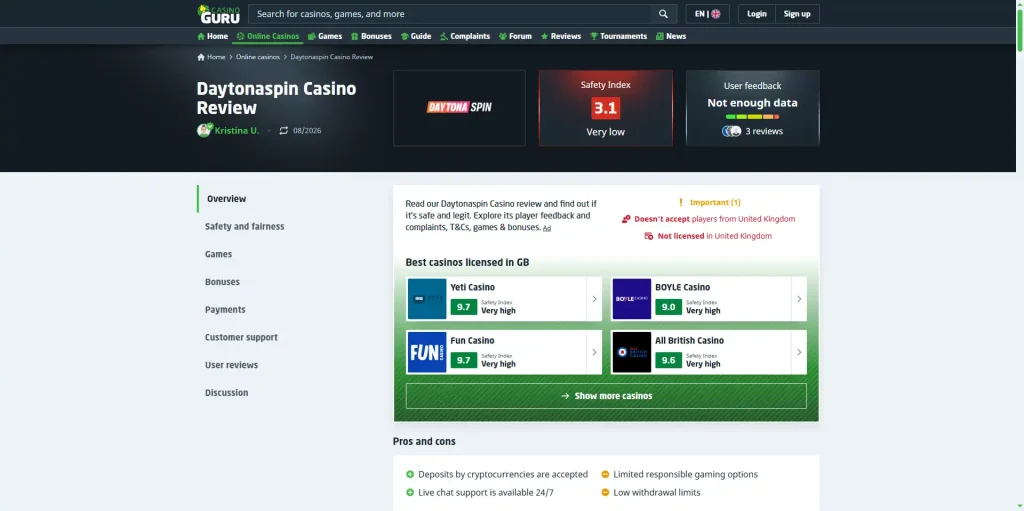
Reviews and complaints
Current reputation signals around Daytona Spin are weak. Casino Guru’s August 2026 review gives the casino a Safety Index of 3.1/10, labelled “Very low”, and its complaint database shows a recurring pattern around delayed withdrawals and verification. The same review lists 19 complaint records in total, including 7 unresolved, 5 resolved and 7 rejected. Trustpilot’s current DaytonaSpin7 profile also skews heavily negative, with 47 reviews in the last 12 months and 94% rated one star at the time checked.
Those numbers are warning signals, not proof that every allegation is true or that every account will have the same outcome. The useful question is what pattern the evidence creates and what extra checks a UK reader should make before depositing.
Read the signal correctly
Table of Contents
- A low rating, complaints and user reviews measure different things
- What the current Casino Guru record actually says
- Withdrawal delays and repeated verification requests appear more than once
- Trustpilot adds volume, but not the same evidential weight
- Why Casino Guru’s 3.1 Safety Index should be treated as an external opinion
- Before depositing
- Before taking a bonus
- Before requesting payout
- Turn complaint evidence into specific checks rather than a binary label
- What the complaints do not prove
- How current Daytona Spin complaints should change a UK player’s due diligence
- Daytona Spin games: library size, categories and providers
A low rating, complaints and user reviews measure different things
Reputation data is easy to over-compress into a single binary label. That loses useful detail. Casino Guru’s Safety Index is an editorial score built from several factors, including terms and conditions, complaint history, estimated casino size and other risk signals. Its complaint records are individual cases with different outcomes. Trustpilot reviews are user-submitted experiences, not adjudicated disputes.
For Daytona Spin, all three layers currently point in a negative direction, but they should still be read separately. The strongest conclusion is that there is enough adverse evidence to justify extra due diligence, especially around withdrawals and verification. It is not evidence that every negative review is independently proven.
Complaint data
What the current Casino Guru record actually says
| Signal | Current figure | What it means |
|---|---|---|
| Safety Index | 3.1 / 10 – Very low | An editorial risk rating from Casino Guru, not a regulator finding. |
| Total complaint records | 19 | The complaint-ratio section lists the full set of recorded cases. |
| Unresolved | 7 | Cases that ended without a resolution in the player’s favour or a mutually confirmed settlement. |
| Resolved | 5 | Cases where the issue was ultimately resolved. |
| Rejected | 7 | Cases not upheld or not accepted as valid complaints under that platform’s process. |
Casino Guru also states that it currently has 7 complaints about the casino in its database and assigns 2,557 black points from those complaints. That wording sits alongside the broader 19-case status breakdown, so the figures should not be treated as the same metric. The practical takeaway is the pattern and the unresolved share, not a manufactured single “complaint count” that ignores how the platform categorises records.
Recurring themes
Withdrawal delays and repeated verification requests appear more than once
The clearest repeated theme in current complaint records is a withdrawal that remains pending while verification continues. Several complaints visible in Casino Guru’s current listing refer to delayed payouts, verification issues or repeated document requests. One UK case submitted in June 2026 concerned a £245 withdrawal that remained unresolved after the player supplied identity, address and payment evidence but was repeatedly asked for a credit-card statement despite saying the deposit had been made by debit card. Casino Guru closed that complaint as unresolved after the casino did not respond to the complaints team.
Another UK complaint concerned a £500 withdrawal that had been pending for less than two weeks. That case was later closed because the player stopped responding after Casino Guru advised allowing more time. This distinction matters: a complaint about a delay is not automatically evidence of non-payment, and the outcome can depend on whether the player, casino and mediator continue engaging.
The pattern still deserves attention because it overlaps with a verified product fact for Daytona Spin: identity verification can be required before withdrawals are completed. The risk is not that KYC exists – KYC is common across gambling services – but that a verification dispute can become the practical bottleneck when money is already waiting to be withdrawn.
User-review context
Trustpilot adds volume, but not the same evidential weight
The Trustpilot profile currently indexed for DaytonaSpin7 shows 47 reviews from the last 12 months, with 94% at one star. Recent entries include allegations about deposits remaining pending and poor support follow-up. This is useful as a sentiment signal because it shows that dissatisfaction is not limited to one complaint platform.
It is still weaker evidence than a documented complaint file. User-review sites can contain genuine experiences, misunderstandings, duplicate narratives, incentivised reviews or claims that cannot be independently checked. For that reason, this page uses Trustpilot to measure direction and frequency of sentiment, not to establish that a particular accusation is true.
A large negative review share is a reason to investigate further, not a substitute for checking the specific payment, KYC and licence facts that matter to your own account.
Editorial rating
Why Casino Guru’s 3.1 Safety Index should be treated as an external opinion
Casino Guru says its Safety Index reflects a combination of terms analysis, player complaints, estimated casino size, blacklists and other factors. In the current Daytona Spin review, it classifies the terms and conditions as unfair, lists five issues, describes the complaint ratio as very bad and identifies the casino as small. It also flags a low withdrawal limit within its methodology.
That is a structured third-party assessment, but it is not an official UK ruling and should not be presented as one. A useful reader response is to inspect the underlying signals that can be independently acted on: withdrawal conditions, verification requirements, dispute handling and regulatory status. Our Daytona Spin licence and safety guide covers the separate UK regulatory question and explains how offshore licensing, Great Britain regulation and simple website access differ.
Before depositing
Read the current cashier and withdrawal terms, note the payment method you use and keep evidence of the deposit source. Avoid assuming that a fast deposit means an equally simple withdrawal.
Before taking a bonus
Read the current promotion terms and save the version that applies to your account. Current third-party sources do not agree reliably enough on exact Daytona Spin bonus mechanics for this guide to freeze a wagering figure.
Before requesting payout
Make sure account details match your identity and payment records. If verification starts, keep a timeline of documents sent, dates, responses and withdrawal status.
Practical due diligence
Turn complaint evidence into specific checks rather than a binary label
A useful complaint page should change behaviour, not merely repeat angry reviews. For Daytona Spin, the current evidence suggests four practical checks. First, verify the current regulatory position before funding an account. Second, use a payment method for which you can readily produce ownership and transaction evidence. Third, avoid depositing more than you are comfortable leaving tied up while verification is unresolved. Fourth, capture the relevant terms and account messages if a dispute begins.
The Daytona Spin withdrawal guide gives the detailed payout checklist and explains why published processing claims should not be treated as guarantees. The Daytona Spin bonus explains why promotion terms deserve their own review rather than being folded into a general reputation score. These are separate decision points, even when they later surface in the same complaint.
Balanced interpretation
What the complaints do not prove
Complaint evidence has limits. It does not show the total number of Daytona Spin customers, so it cannot establish a precise failure rate. A resolved complaint demonstrates that a problem occurred but also that a resolution was reached. A rejected complaint may fail for evidential or procedural reasons. A user review can be sincere without being independently verifiable.
There are also product facts that should not be erased by reputation data. Daytona Spin has a large reported games catalogue, supports multiple payment categories and offers 24/7 live-chat support according to current third-party sources. Those features may matter to users, but they do not cancel the documented complaint pattern. The full Daytona Spin UK review keeps product features and risk signals in the same decision framework instead of allowing either side to dominate the conclusion.
Decision framework
How current Daytona Spin complaints should change a UK player’s due diligence
The current record supports a cautious decision process. Casino Guru’s 3.1/10 Safety Index is very low, its complaint history includes multiple unresolved withdrawal and verification disputes, and the indexed Trustpilot profile is overwhelmingly negative. Those signals are strong enough to justify more verification before depositing and a lower tolerance for unclear payment or KYC terms.
They are not a licence ruling and they do not prove every allegation. For a UK reader, the most useful response is therefore concrete: check the current licence position, read the withdrawal terms before funding the account, keep payment and identity records ready, and avoid relying on promotional language or a single review score as a substitute for those checks. When the downside is delayed access to your own funds, the quality of the withdrawal and dispute process matters more than the headline size of a bonus.